

Bring clinical operations, bioanalytical LIMS, pharmacy management, eTMF and CRO centre planning into one connected BA/BE study environment. Connect a searchable participant recruitment database and study-specific eConsent to biometric-enabled screening, test/reference product accountability, barcode sample traceability, pathology and LC-MS/MS instrument data, eTMF records and attributable audit trails throughout the study lifecycle
One connected journey
Clinical -> lab -> delivery
Identity-led screening
Optional biometric interfaces
Barcode traceability
Collection to reconciliation
Centre-wide insight
Resources, capacity, progress
BA/BE studies depend on precise execution across recruitment, controlled dosing, timepoint sampling, laboratory processing and independent data review. A digital platform works best when each team shares an accurate operational picture.
Keep study, subject, activity and sample information connected so authorised teams work from linked records instead of isolated spreadsheets.
Follow samples from collection and barcode identification to lab receipt, analytical runs, reanalysis, QC and concentration-data release.
Connect slotting, bed and staff allocation, clinic workload, analytical demand and study milestones in one management view.
Explore each operational module, including investigational product accountability and eTMF document oversight. Workflows can be configured to your protocol, laboratory methods, validated interfaces, SOPs and access controls.
Search a consent-aware participant database for recruitment, manage recontact and prior participation checks, deliver study-specific eConsent, then coordinate biometric identity verification, medical screening, dosing, PK sample collection and clinical review. Link every authorised action to the participant, study and activity audit history.
Find --> Recontact check --> eConsent --> Verify --> Screen --> Enrol --> Dose --> Collect --> Review
Use a controlled volunteer registry to search pseudonymous profiles, recruitment availability, screening history and permitted recontact status; avoid duplicating records across studies.
Manage approved informed-consent versions, accessible participant review, questions, electronic signatures, copy delivery, consent withdrawal and amendment-triggered reconsent.
Volunteer profiles, subject history, authorised prescreening and investigator-led protocol-specific eligibility decisions.
Configurable identity verification and duplicate-subject review with authorised alternative processes.
Study-specific periods, cohorts, treatment schedules, visits, timepoints and activity rules.
Controlled CRF changes, historical versions, edit checks and review status.
Task windows, planned versus actual activities, staff allocation and deviations.
Scan subject and sample labels to associate activity records and collection metadata.
Import ECG and pathology results through compatible LIS / instrument formats, with subject-visit matching, units, reference ranges, flags and investigator acceptance.
Import ECG and pathology results through compatible LIS / instrument formats, with subject-visit matching, units, reference ranges, flags and investigator acceptance.
Import ECG and pathology results through compatible LIS / instrument formats, with subject-visit matching, units, reference ranges, flags and investigator acceptance.
Collection, processing, aliquots, storage, manifests, shipping and handover records.
Medical review, protocol deviations, data queries and period-close readiness.
Recruitment funnel, permission status, consent completion, screening, dosing activities, collection windows and study status.
Capture attributable, time-stamped subject-record creation, assessments, corrections, approvals, consent events and workflow changes with reason codes where required.
Manage sample receipt, bioanalytical method versions, batch requests, analysis runs, repeats, ISR, independent QC and authorised concentration-data release without losing the original analytical history.
Receive --> Reconcile --> Batch --> Analyse --> Review --> Repeat / ISR --> QC --> Release
Study, analytes, matrix, method, sample definitions and method versions.
Configured assay-specific validation tasks, results and documented acceptance decisions.
Sample check-in, shipment verification, discrepancy handling and storage tracking.
Match analytical inventory to clinical manifests, aliquots and expected collections.
Separate demand planning from execution runs and instrument allocations.
Link compatible LC-MS/MS / CDS run exports, vial and sample IDs, analyte concentrations, calibration/QC results and supported chromatographic files to an auditable batch.
Reason-coded reanalysis, incurred-sample comparisons and complete original-result history.
Review calibration, QC, method criteria, investigations and release authorisations.
Versioned release of reviewed results with sample, timepoint, analyte and unit information.
Batch backlog, instrument utilisation, review queues, ISR status and turnaround.
Coordinate a portfolio of BA/BE projects while balancing clinical slots, beds, people, laboratory instruments and milestones. See how study execution affects capacity and delivery plans.
Plan --> Check capacity --> Allocate --> Slot --> Execute --> Monitor --> Adjust --> Close
Study records, owners, milestone schedules and operational dependencies.
Reserve screening, study periods, wards, available beds and required schedules.
Plan staff, clinic facilities, sample-processing resources and instruments.
Consolidated planned, screening, clinical, analytical and closed statuses.
Screening performance, bed occupancy, cohort progress and clinic workload.
Batch demand, method workload, instrument booking and analysis queues.
Recruitment volumes, eligible participants, reasons for failures and future demand.
Live exceptions, milestone risks and consistent study-to-centre KPI definitions.
Manage test and reference product inventory, temperature oversight, study/period allocation, controlled dispensing and dose reconciliation. Preserve blinding and separation of roles while linking pharmacy records to clinical dosing and essential trial documentation.
Receive --> Quarantine --> Release --> Allocate --> Dispense --> Dose --> Reconcile --> Return / Dispose
Receive test and reference investigational products by batch/lot, quantity, expiry, shipment condition and supplier documentation.
Apply quarantine/release states and authorised pharmacist approval before stock becomes available.
Record storage conditions, excursions, location changes and applicable investigation outcomes.
Associate dispensation with approved study, period, subject and treatment code while preserving required blinding.
Control pack/barcode identities, label checks, issue quantities and authorised preparation records.
Record product issue to the clinic and reconcile administered or unused units with clinical dose confirmation.
Trace unused, returned, damaged or lost units and investigate accountability discrepancies.
Authorise returns, destruction or alternate disposition; prepare stock ledger and reconciliation evidence.
Use an electronic Trial Master File to track essential records from study setup to closeout: filing plans, record classification, version control, authorisation, completeness, quality review and inspection-ready archival.
Plan --> Generate / Collect --> Classify --> Review --> Approve --> File --> Monitor --> Archive
Create study- and organisation-specific essential-record structure; configure DIA TMF Reference Model alignment if appropriate.
Capture artifact type, study, country/site, owner, effective date, version and status.
Maintain source files and document supersession, check-in, review trail and retrieval.
Route essential records for completeness, accuracy, authorisation and electronic signatures where applicable.
Set document milestones and identify missing, overdue or outdated essential records.
Associate protocol versions, pharmacy accountability reports, method records, sample logs and other applicable evidence.
Support sponsor, CRO and site responsibilities, permission separation, download history and inspection access.
Track completeness, resolve filing gaps and prepare searchable retained study records for closeout and archival.
Use these workflow views to understand the operational handoffs inside each module. Each step lists the core activity and the data or decision passed to the next team.
Protocol, CRFs, versions, visit calendar, cohorts, dose times, edit checks and staffing.
Output: approved study configuration
Filter permitted participant profiles by study interest, prior participation, availability and recruitment permissions. Require human review before outreach.
Output: approved recruitment shortlist
Check lawful basis, communications preferences, study restrictions and permitted recruitment history before sending an invitation.
Output: permission-checked invitation
Present approved consent version; answer questions; capture valid participant agreement, signer details and copy delivery prior to protocol screening.
Output: signed and versioned consent record
Link the participant profile; use authorised fingerprint/face matching or approved alternate identity verification.
Output: verified screening identity
History, vital signs, ECG/pathology interfaces and investigator-led protocol-defined eligibility review.
Output: eligibility decision
Admission, scheduling, identity checks, dosing and protocol-defined activities.
Output: signed clinical events
Barcode, planned/actual times, processing, aliquots, freezer location and shipment.
Output: sample manifest & custody
Resolve missing/late samples, deviations and data queries; approve period records.
Output: reviewed clinical dataset
Assign analytes, matrix, method version, validation status, calibration and QC rules.
Output: authorised method setup
Receive barcode manifests, verify condition and quantity, record location and exceptions.
Output: accepted laboratory inventory
Plan workload, assign instrument and staff, add calibrators/QCs and construct analytical runs.
Output: planned analytical batch
Receive chromatographic or other supported outputs; assess run and QC criteria.
Output: traceable analysis record
Record reanalysis justifications, retain original results and perform qualifying ISR checks.
Output: documented review decisions
Independent QC, approvals, reconciliation and versioned data delivery for PK/statistics.
Output: approved concentration dataset
Register study award, owner, major milestones and targeted clinic/lab deliverables.
Output: project baseline
Assess beds, study periods, staffing, screening volumes, washout and lab resources.
Output: feasible study slot
Reserve clinical teams, wards, laboratories and instruments against the schedule.
Output: released capacity plan
Collect progress, screening outcomes, sample throughput and batch execution status.
Output: consolidated live status
Review clinic occupancy, sample backlogs, lab utilisation and missed milestones.
Output: approved rescheduling decisions
Compare planned versus actual capacity, turnaround and study throughput.
Output: centre performance dashboard
Record test/reference product, supplier, batch/lot, quantities, expiry, package identity and shipping conditions.
Output: quarantined stock ledger
Document receipt checks, excursions, approvals and release from quarantine.
Output: authorised available inventory
Assign approved study/period treatment code and authorised quantities with blinded role segregation.
Output: controlled allocation record
Verify label/barcode and product issue; record handover to clinic with staff identities.
Output: dispensing / custody log
Link dosing confirmation, unused stock, returns, damaged units and deviations.
Output: subject-period accountability
Approve final reconciliation, returns/destruction or alternative disposition and file essential records.
Output: signed pharmacy reconciliation
Create expected essential-record list with study metadata, owners, document milestones and applicable taxonomy.
Output: approved filing structure
Receive protocol amendments, training, pharmacy accountability, laboratory and clinical records as appropriate.
Output: document intake queue
Index documents by study, role, country/site, version, artifact, dates and effective state.
Output: searchable essential record
Check content completeness, correct version, signatures, missing pages and controlled approval requirements.
Output: dispensing/custody log
Identify expected, outstanding, overdue and superseded documents; route gaps to accountable owners.
Output: completeness/inspection dashboard
Resolve filing issues, export inspection packages and apply authorised retention/access rules.
Output: inspection-ready archive
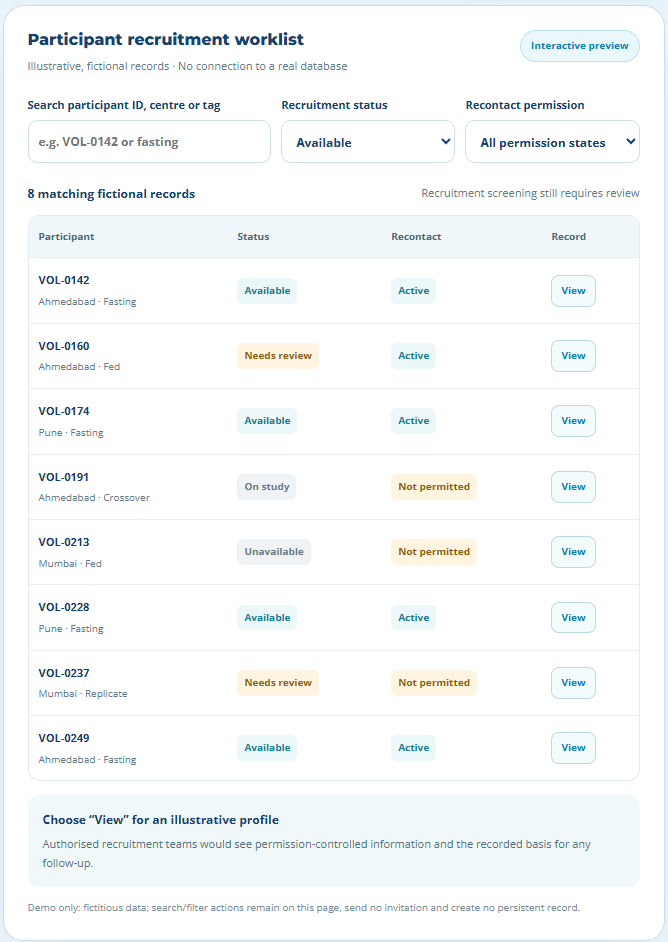
Keep one controlled participant registry across study opportunities. With appropriate permissions, recruiters can search previous volunteers, check recruitment status and past participation, manage recontact preferences, and prepare a prescreening shortlist without repeating registration work.
Controlled participant ID, contact permissions, recruitment history, previous screening outcomes and study participation records. Identity and sensitive medical data remain permission-restricted.
Find records using permitted identifiers and structured filters for centre, availability, previous participation, prescreening status and recruitment interests.
Apply consent and recontact restrictions, potential washout or concurrent-study conflicts, current availability and study-specific investigator review before outreach.
Monitor contact permission, invitations, responses, planned screening, screen failures and enrolment with attributable updates and auditable decisions.
Permission to recontact, consent to take part in a particular study and lawful biometric processing are different decisions. A database match or recruitment shortlist is never proof of medical eligibility.
Privacy context: UK ICO biometric recognition guidance. Recontact permissions and registry access require centre- and jurisdiction-specific lawful processing rules.
Previous participation and screening events
Recontact status, preference and suppression
Human review before eligibility decisions
Traceable invitations, decisions and changes
Link the approved participant information sheet and informed-consent form to the correct study, site, language and effective date. Preserve superseded versions.
ICF version and approval details · language · effective date · study/site linkage
Stage 1 of 5
Study consent is distinct from recruitment recontact permissions and biometric data processing. Qualified staff must be available to answer questions, and withdrawal is handled under applicable requirements.
Present the study consent invitation securely, verify the correct participant according to the consent process and distinguish recruitment permission from study participation.
Invitation method · participant reference · identity verification event
Stage 2 of 5
Study consent is distinct from recruitment recontact permissions and biometric data processing. Qualified staff must be available to answer questions, and withdrawal is handled under applicable requirements.
Provide appropriate plain-language materials and accessible support. Allow discussion with trained staff, time for questions and additional comprehension checks where required.
Information version displayed · review record · support and discussion entries
Stage 3 of 5
Study consent is distinct from recruitment recontact permissions and biometric data processing. Qualified staff must be available to answer questions, and withdrawal is handled under applicable requirements.
Record a voluntary participation decision with the correct document version, signer identity, intended meaning, timestamp and appropriate staff acknowledgment; make a copy available.
Signature manifestations · document hash/version · staff attestation · copy delivery
Stage 4 of 5
Study consent is distinct from recruitment recontact permissions and biometric data processing. Qualified staff must be available to answer questions, and withdrawal is handled under applicable requirements.
Trigger reconsent when required by an approved amendment; preserve prior consent states, record withdrawal or recontact preferences, and file regulated evidence with the study.
Reconsent history · withdrawal/change events · archival and eTMF links
Stage 5 of 5
Study consent is distinct from recruitment recontact permissions and biometric data processing. Qualified staff must be available to answer questions, and withdrawal is handled under applicable requirements.
Study, site and language assignment; approved effective dates; previous-version retention and participant copies.
Clear consent materials, optional multimedia explanations, comprehension support and documented opportunities for questions.
Identity, signer role, action meaning, date/time, electronic signing controls and staff acknowledgement where applicable.
Amendment-triggered tasks, new consent events, opt-out/withdrawal status, notifications and linked eTMF evidence.
Applicable requirements depend on jurisdiction, approved protocol, ethics review, participant circumstances and validated implementation. See FDA electronic informed-consent guidance.
Give pharmacy and clinical teams a controlled record of investigational product (IP/IMP) receipt, inventory, allocation, storage, dispensing, administration reconciliation and final disposition. Product issue is not the same as confirmed dosing: both events are linked without losing their separate accountability.
Use study-specific pharmacy rules for inventory release, treatment-code visibility, stock movement, dosing handovers and deviations. Link the relevant lot and dispensed pack to the dose, while restricting unblinded information to authorised staff.
Set up the study structure, document list, accountable owners, expected milestones, taxonomy and metadata. Align with the DIA TMF Reference Model where appropriate.
Study -> product type -> lot / kit -> subject / period -> pharmacy dispense event -> clinical administration -> reconciliation record.
Manage essential records in a central electronic Trial Master File (eTMF) with a study-specific filing plan, document metadata, controlled versions, review responsibilities and continuous visibility of missing or overdue records. The file should reflect the sponsor/CRO/site responsibilities and records actually required for the study.
Set up the study structure, document list, accountable owners, expected milestones, taxonomy and metadata. Align with the DIA TMF Reference Model where appropriate.
Link protocol and ethics documentation, consent templates, delegation/training, pharmacy reconciliation and relevant laboratory method, sample and review records.
Route draft, review, approval and final filing. Manage supersession, timestamps, signatures where applicable and exceptions without deleting earlier versions.
Monitor expected vs filed documents, pending reviews, overdue records, missing artifacts and study closeout completeness.
Support inspection access, controlled export, archive status, retention policies and quick retrieval of approved records. Records held externally can be referenced with ownership and location rather than duplicated without reason.
Designed with reference to DIA TMF Reference Model and ICH E6(R3) essential records; configuration, retention and inspections depend on applicable regulations and SOPs.
Downstream PK and bioequivalence statistics are a separate service or system integration, depending on the agreed scope.
Configure user permissions and appropriate separation between clinical, laboratory, QC and management activities.
Record attributable, time-stamped critical user and system actions across recruitment, eConsent, clinic, pharmacy, laboratory, eTMF and administration.
Define protocol-specific time windows, data checks, laboratory acceptance criteria and controlled exceptions.
Manage analytical run review, repeat justification, ISR, independent QC and authorised data release.
Track expected and collected samples, shipment receipts, analysis events and reportable data in linked records.
Prepare traceable concentration exports and support downstream analysis, reporting and retention obligations.
Regulatory context and implementation scope: Software features may support controls relevant to ICH E6(R3), ICH M10 and applicable electronic-record requirements. Compliance is not automatic: configuration, validation, SOPs, access controls and deployment-specific procedures remain necessary. Biometric identity processing requires additional privacy controls. Pharmacy accountability and essential-record controls should follow applicable GCP requirements, and LC-MS/MS/ISR workflows should be configured with reference to ICH M10. eTMF classification can use the DIA TMF Reference Model where appropriate.
Reduce manual transcription by linking results from supported clinical diagnostic systems and analytical instrument software into controlled clinical and LIMS review workflows. Every interface requires device/vendor-specific feasibility, field mapping, error handling and intended-use validation.
Import lab results from compatible pathology analysers, laboratory information systems (LIS) or configured secure file/API transfers. Match results to the expected subject, screening/visit and order; display units, ranges, abnormal/critical flags and verified review status.
Potential standards include HL7 v2, HL7 FHIR, ASTM or vendor export formats only where supported by the source system and mapping.
Link compatible LC-MS/MS chromatography data systems (CDS) to analytical batches using sample/vial and run identifiers. Transfer supported processed concentration results and the associated method, instrument, calibration/QC and source-file references for technical review.
A CDS interface does not substitute for chromatographic processing, scientifically appropriate run acceptance or original raw-data retention. Vendor capability varies.
Associate compatible device measurements, timestamps, interpretations or linked waveform files to the correct volunteer and visit. Provide a review queue for unmatched results and medically significant findings before clinical acceptance.
Integration patterns are configured to each centre’s supported equipment, data formats and qualification needs.
Fingerprint or facial verification through compatible devices and matching services, subject to local privacy controls.
Pathology analyser or LIS results (units, ranges and flags), ECG and other clinical equipment with subject/visit matching and medical acceptance.
LC-MS/MS chromatography/CDS results, analytical metadata, QC/calibration outputs and supported source-file links via validated interfaces.
Approved concentration datasets transferred in documented formats for PK, bioequivalence statistics or final reporting.
Standardise protocol execution, participant screening, resource scheduling and sample accountability across studies.
Coordinate sample inventory, method-specific analysis, repeats, ISR, technical review and concentration-data release.
Improve visibility into milestones, screening outcomes, clinic capacity, laboratory progress and delivery dependencies.